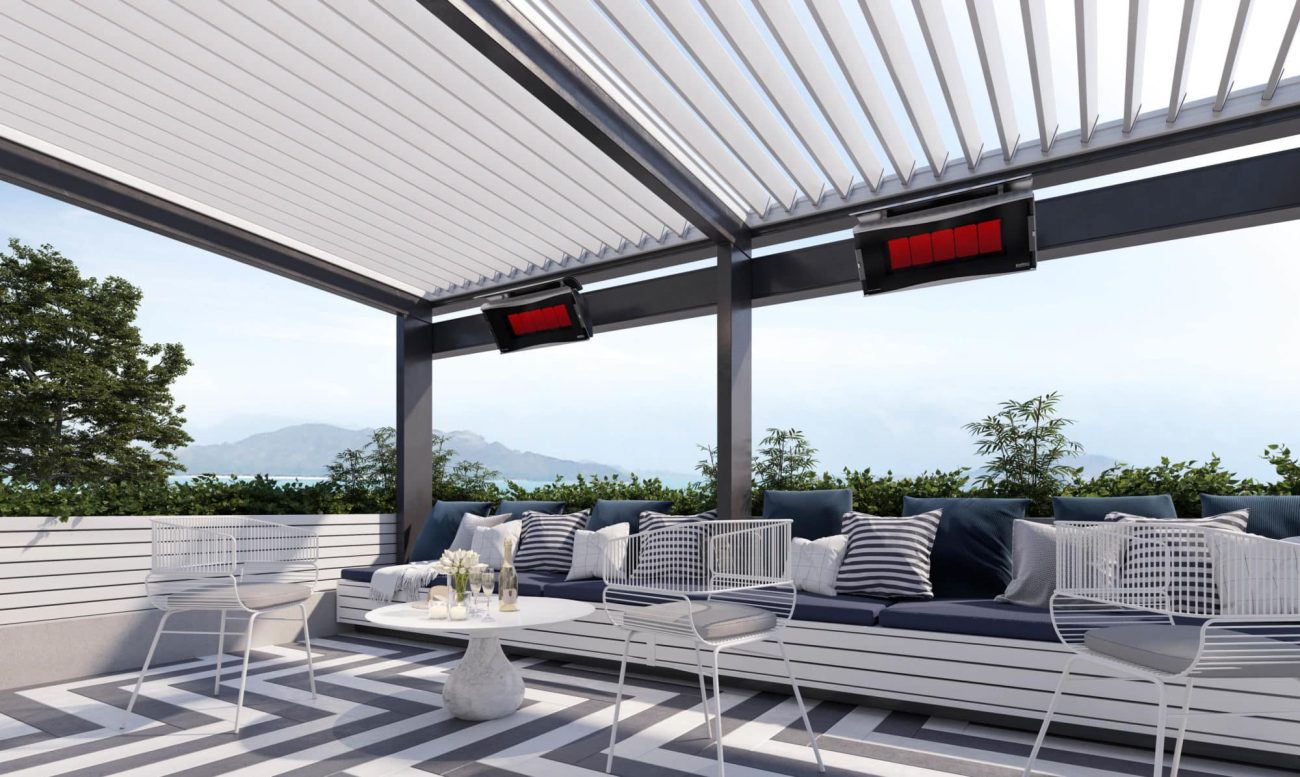
If your Toronto patio goes dark in mid-October while guests are still asking for a table outside, the fix is usually smaller and cheaper than you think. A mid-size GTA restaurant patio typically needs four to six mounted infrared heaters, laid out in zones that follow the seating plan, and a restaurant patio heater system like that usually pays for itself inside one or two shoulder seasons. What follows is a case study of how the project comes together, built on a typical mid-size Toronto patio rather than one client’s private numbers, because the decisions are the same on almost every job.

Ceiling-mounted Bromic heaters above an outdoor dining table at dusk. The heat lands on the seats, not on the air above them. Photo: Bromic
The starting point: a good patio that closes too early
Picture a 40 to 50 seat patio off a Queen West or Danforth restaurant. The room is booked solid in July. By the second week of October, the reservations move inside, the patio sits empty after 7pm, and the manager starts pulling the seasonal furniture out a few pieces at a time. Meanwhile the guests are still there. They just want to be warm.
The usual answer is a cluster of propane mushroom heaters. They help for a while. Then you notice three things: the people under them are still wearing coats, somebody has to haul cylinders out of the basement on a Saturday night, and two units have already failed since spring. That is the point where a fixed heating system starts to look less like a luxury and more like arithmetic.
Step one: measure in zones, not in square feet
This is where most patio heating plans go wrong. A heater is not sized to a total floor area. It is sized to a seating zone, and a zone has a shape.
On a typical patio we would map it like this:
- The covered strip. Anything under an existing awning, canopy or pergola. This is the easiest and cheapest heat to deliver, because the structure already holds the warmth in and gives you somewhere solid to mount.
- The open middle. Tables with nothing overhead. Heat here has to be aimed and it has to be powerful enough to survive a breeze.
- The edges. Along the street, along a laneway, along the railing. These seats lose heat fastest and are the ones guests complain about first.
Walk the patio at 8pm on a cool evening before you plan anything. Wind direction at dinner service decides the layout more than any floor plan.
Step two: choose the mounting structure
Overhead structure is the single biggest lever on both cost and comfort. A wall, a soffit, a beam, a pergola frame, or the underside of a retractable awning all give you a rigid, spec-compliant mounting point at the right height. Nothing else does.
If the patio already has shade, you are most of the way there. If it does not, and you are planning a canopy or a louvered pergola anyway, design the heat and the shade together. Retro-fitting heaters under a structure that was never planned for them tends to cost more and look worse. We install both systems, and the projects that go smoothest are always the ones where shade and heat were drawn on the same page.
Step three: electric under cover, gas in the open
Once the zones are drawn, the fuel choice usually sorts itself out.
Electric infrared goes under any covered area. It is silent, produces no combustion emissions, which matters for semi-enclosed and rooftop patios, and it runs on a dedicated circuit. At Ontario commercial rates a 2,000W unit costs roughly 30 to 40 cents an hour to operate, so running four of them through a dinner service is a rounding error next to the covers they support. The catch is wiring: you need an electrician and often a new circuit, which is much easier before the season than during it.
Gas infrared covers the tables with nothing above them. The 500-series units we install put out around 43,000 BTU/hr of directional heat, which is what it takes to hold a seat on an open patio on a windy November night. Gas needs a licensed fitter and either natural gas or propane supply.
Many restaurants end up with both, hardwired electric under the cover and gas for the open section, which is exactly the split you would expect from the zone map.
Step four: zone the controls
This detail separates a sensible heating bill from a painful one. Group your heaters so the front half of the patio can run while the back half stays off. Add dimming or step control, because a half-full patio does not need full output. On the projects we install, the manager should be able to heat the seated area only, from one or two switches, without walking the patio to check which units are on.
The payback math, modelled honestly
Every patio is different, so treat these as planning ranges rather than a quote. Individual Bromic commercial heaters generally run from the low four figures up to the low five figures per unit. A typical installation, meaning four to six heaters plus mounting hardware, controls and licensed electrical or gas work, usually lands somewhere in the $10,000 to $25,000 installed range.
Now run it against your own numbers. Take the covers your patio seats on a cool October evening, multiply by your average ticket, then by the extra weeks the heat buys you. As an illustration: 12 extra covers a night, three nights a week, six extra weeks, at a $60 average ticket, is about $13,000 in added revenue. That is one season. Everything after that is margin, and you are no longer paying for propane refills or replacing cheap heaters every second year.
Plug in your own covers and ticket and the answer gets obvious fast. If your average ticket is higher, or your patio is bigger, the case gets stronger, not weaker.
What to get right before you commit
- Mounting height and clearance have to follow the manufacturer’s spec for the surface. Attached is not the same as installed correctly.
- Licensed trades are not optional. Electric heaters need an electrician, gas units need a gas fitter.
- Insurance and bylaw compliance on a commercial patio generally expect certified, professionally installed equipment. Sort this before the first cold weekend, not after.
- Winter wind is the real test. On the open edges, pair heat with wind protection. Zip screens or glass panels keep the radiant warmth where you aimed it, and they are the cheapest upgrade per degree.
The takeaway
Extending a Toronto patio season is not a marketing problem, it is a layout problem. Map the zones, mount to structure, match the fuel to the exposure, zone the controls, and the numbers do the rest.
Browse our full lineup of Bromic commercial patio heaters, or look at the wider commercial shade and heating solutions we install across Toronto, Mississauga, Oakville, Burlington, Hamilton and the rest of the GTA. If you want the layout drawn against your actual seating plan, book a free on-site assessment and we will size it properly.