
Infrared patio heaters keep you warm by heating people, chairs and surfaces directly with radiant energy instead of trying to heat the air around them. That one difference matters more in Canada than almost anywhere else: when a November wind sweeps across a GTA patio, warmed air simply blows away, but radiant heat keeps reaching you. For most homeowners and restaurant owners around Toronto, a radiant infrared heater — electric or gas — delivers more usable warmth through a Canadian winter than the familiar propane “mushroom” heater. Here’s how the technology works, and why we specify it for our own installations.

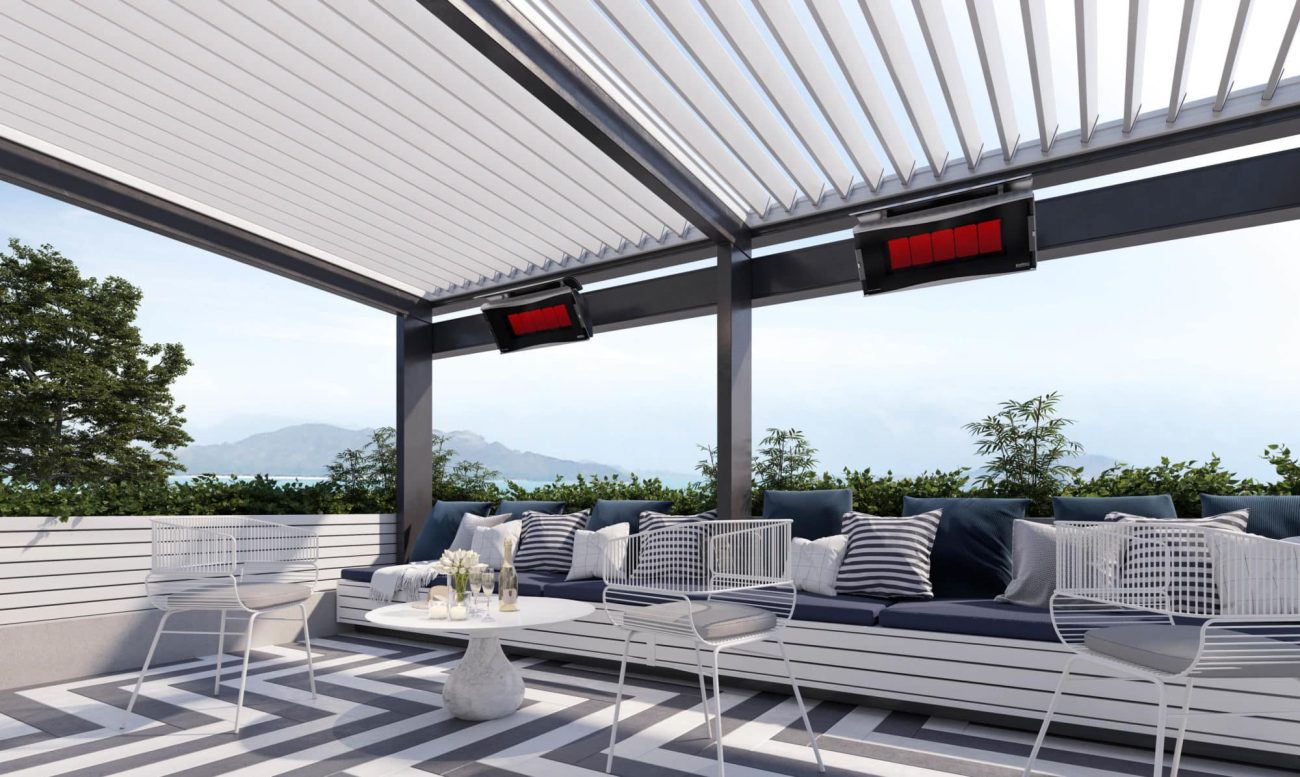
A Bromic Platinum gas radiant heater in place — radiant heat reaches people directly, even as air moves across the patio.
How radiant heat actually works
Think of a bright but cold day in early March: the sun feels warm on your face even though the air is still near freezing. An infrared patio heater works on the same principle. A radiant patio heater — whether it uses a glowing electric element or a gas burner in front of a high-output surface — sends heat out in a directed beam that warms whatever it touches: you, your guests, the table, the floor. You feel it within seconds of switching on.
A conventional propane patio heater, by contrast, is mostly a convection device. It burns fuel to heat air, which rises and spreads outward from that familiar mushroom-shaped reflector. On a perfectly still evening that can work fine. On an open rooftop, a lakeside deck in Hamilton or a backyard in Markham with the usual breeze, a good share of that warmed air drifts away before it ever reaches anyone.
Do infrared heaters warm the air at all?
Only indirectly — surfaces that absorb radiant energy give a little of it back over time. The design goal is direct warmth, which is why radiant units are the go-to choice for open, windy or high-ceilinged spaces where convection heat struggles to keep up.
Why wind decides the argument
Wind is the great equalizer on Canadian patios, and it’s where the two approaches genuinely diverge:
- Convection heat needs still air. Every gust peels away the warm bubble a propane mushroom heater works so hard to create. In breezy conditions, most of that heat is simply lost to the open sky.
- Radiant heat travels in a straight line. The beam keeps arriving at people and surfaces no matter what the air between is doing. A breeze chills you faster, but it doesn’t switch the heat off.
- Placement flexibility. Because radiant heat is directional, units can be wall- or ceiling-mounted and aimed exactly where people actually sit, instead of hoping warm air happens to wander there.
That’s why radiant designs are a common spec for open restaurant patios in Toronto that keep running into the colder months.
Infrared vs. conventional propane, side by side
- Warm-up: radiant heat is felt almost immediately; a mushroom heater needs time to build a warm-air zone around itself.
- Wind performance: radiant wins by a wide margin in real-world breezy conditions — the beam keeps working while convected heat blows off the patio.
- Fuel and controls: electric infrared runs off a switch, timer or dimmer, with no tanks to refill and no pilot to fuss with; gas radiant offers high output where a gas line is already in place.
- Operating cost: depends on current propane and electricity prices in Ontario; the efficiency principle favours any system that puts heat where the people are instead of the open air.
Electric or gas infrared?
Radiant heat comes in both fuel types, and the Bromic infrared lineup we carry covers both. Bromic’s gas radiant units, like the Platinum Smart-Heat series pictured above, deliver serious directed output for larger open patios. Electric infrared units are easier to control with a dimmer, need no refills and mount cleanly under eaves, pergolas or awning frames. If you’re adding warmth to a space that already has Canadian Shade overhead — a pergola or retractable awning — an electric unit tucked into the frame is often the tidiest winter upgrade there is.
A conservative word on running costs
We’ll be straight with you: exact operating cost depends on propane prices and hydro rates, and both move season to season. What’s safe to say is that an electric infrared heater delivers essentially all the energy it draws as heat, right where you’re sitting, while a propane heater’s output has to survive the trip through moving outdoor air first. For a typical GTA household running a heater for a few hours on weekend evenings, the difference shows up less on the utility bill than in how many evenings the heater was genuinely useful. If budget certainty matters, we’re happy to run a quick comparison based on your patio’s size and layout.
Choosing the right setup for your patio
Mounting height, coverage area and wind exposure are the three variables that decide what you need. A compact urban balcony in Toronto might get by with a single well-placed unit; a large restaurant patio in Oakville or Mississauga needs a designed layout with overlapping coverage zones. That’s exactly the kind of planning we do every day. See our full patio heater collection for models and specs, or send us a photo of your space and we’ll suggest a layout that keeps the whole seating area comfortable — wind or no wind.